Asia/Karachi
BlogOctober 1, 2026

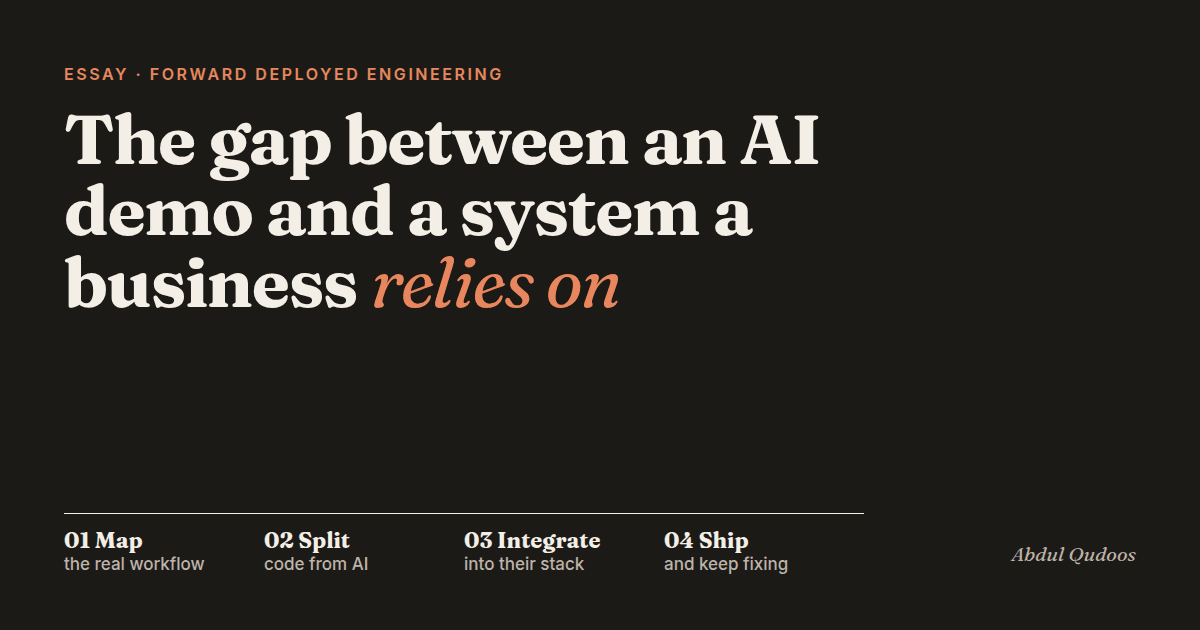
The Gap Between an AI Demo and a System a Business Relies On

Six things that never show up in the demo, and always show up in production
Abdul Qudoos
The Gap Between an AI Demo and a System a Business Relies On — Abdul Qudoos blog cover
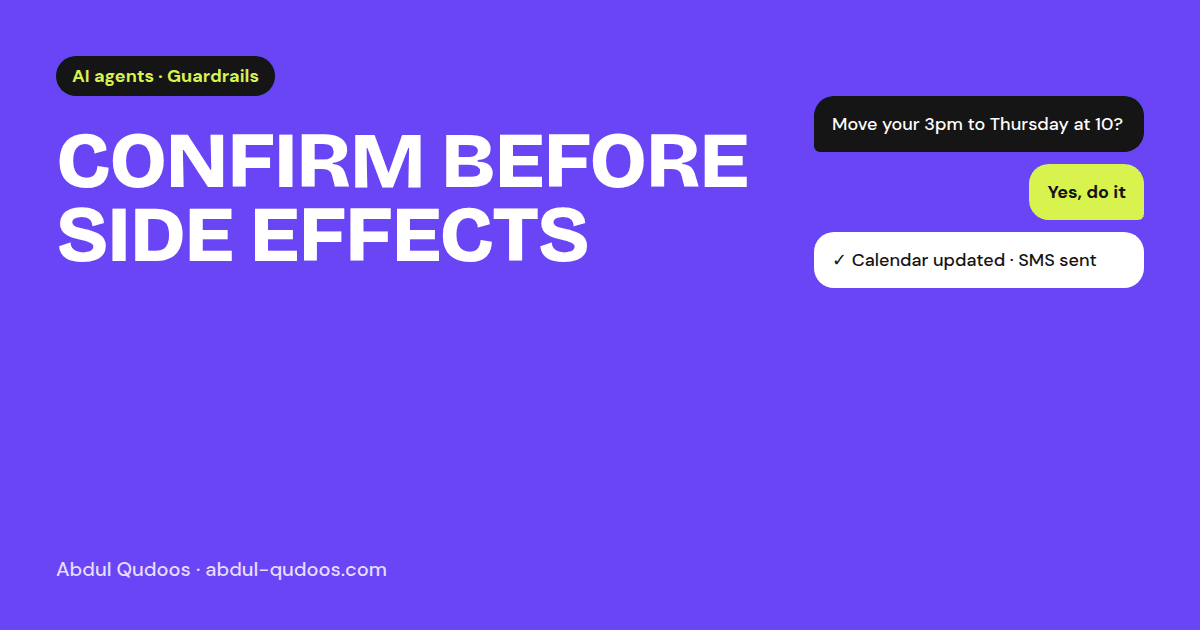
A demo has one user, who knows exactly what to say. The input is clean and the network is fast. If something goes wrong, you click "run" again. A business has hundreds of users who say things you never expected, on bad phone lines, at the worst possible moment, and nobody clicks "run again" for them. The distance between those two worlds is where most AI projects quietly die. It's also the entire job of a forward deployed engineer. Here are the six gaps I run into on almost every project, with real examples of how each was closed. In the demo: a nicely typed question. In production: 8 kHz phone audio, background noise and misheard words. In a live call translator I built, transcripts arrive full of small errors. The fix wasn't a better microphone. It was asking the translation model to repair obvious transcription errors as part of its job, using the recent conversation as context. Close the gap: test with the worst real input you can find, not the best. In the demo: nobody notices a two-second pause. In production: on a phone call, two seconds of silence sounds like a dropped line. In a voice agent, a single Google Calendar update took about 2.19 seconds. We couldn't speed up Google, so we hid the wait with pre-recorded filler phrases and preloaded calendar data at the start of the call. Close the gap: measure every step, then remove what you can and hide what you can't. In the demo: the AI answers every question beautifully. In production: it answers questions your data never covered, just as beautifully, and wrongly. A handbook assistant I built uses a 0.25 similarity threshold. If nothing in the handbook matches well enough, it says so instead of guessing. Close the gap: decide what "not confident enough" means, and enforce it in code. In the demo: the agent books the meeting. Applause. In production: the agent books the wrong meeting for a real customer. Every tool that changes something should refuse to run without explicit confirmation, enforced in the tool's code, not just requested in the prompt. Close the gap: list every side effect, and gate each one. In the demo: every service responds. In production: a provider has an outage on a Tuesday afternoon. An outreach tool I built falls back to a template email when the model is unavailable, so the team's work doesn't stop because a single API failed. Close the gap: for every external call, write down what happens when it fails. In the demo: the project ends when it works once. In production: that's when it starts. Real users find the paths you didn't design. On the voice agent, a caller saying "I need help rescheduling" and then "yes" once dropped straight out of the workflow. The fix was a better intent example, found only by reading real transcripts. You won't find these fixes in a planning meeting. You find them in the logs, after launch. Close the gap: plan for weeks of iteration after launch, not just a handover.
GapDemoProductionFix
InputClean textNoisy, messy, partialTest with real input and let the model repair it
SpeedUnnoticedDead air on a callMeasure, preload, fill
ConfidenceAlways answersConfidently wrongThresholds and refusals
ActionsBooks the meetingBooks the wrong oneConfirmation in code
FailuresNever happenHappen on TuesdayFallbacks
After launchDoneJust startingRead logs and iterate
None of these fixes are glamorous, and none of them make a demo look better. All of them make the difference between a system a business tries once and one it relies on every day.
Have an AI demo that needs to survive real users? That's exactly what I do.
Share this post: