The core decision every SaaS makes
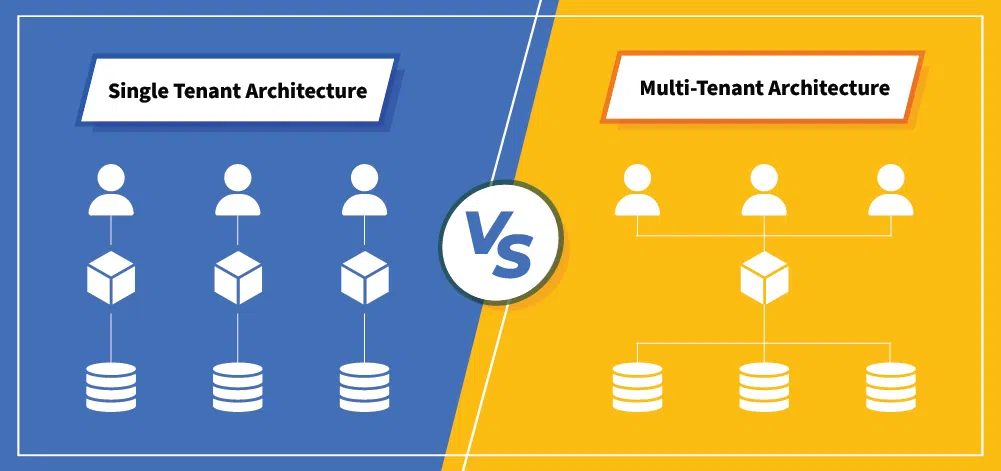
Single-tenant: one instance, one customer
- Complete data isolation by design — no shared-schema bugs can leak data between customers
- Deep customization per client without touching anyone else's environment
- Predictable performance — no noisy-neighbor effect from another tenant's traffic spike
- Simpler compliance story for regulated industries (healthcare, finance, government)
- Infrastructure spend scales linearly with customer count — 100 customers means (roughly) 100 sets of resources
- Every feature release, migration, or patch has to roll out per-instance
- Operational overhead grows fast without strong automation (IaC, CI/CD per tenant)
Multi-tenant: one instance, many customers
- Lower cost per customer — shared compute and storage instead of per-tenant duplication
- One deployment to maintain — ship a fix once, every tenant gets it
- Easier horizontal scaling — add capacity to the shared pool instead of provisioning per customer
- Faster time-to-value for new signups — no per-tenant infrastructure to spin up
- Isolation now depends on application-level discipline — a missing tenant_id filter is a data leak, not a config error
- A runaway query from one tenant can degrade performance for others without careful resource governance
- Deep per-tenant customization is harder without a plugin/config-driven design
Database isolation strategies for multi-tenant systems
- Shared database, shared schema — every table carries a tenant_id column; cheapest and simplest, but isolation is entirely enforced in application code and row-level security policies.
- Shared database, schema-per-tenant — each tenant gets its own schema inside one database instance. Stronger isolation than a shared schema, still one database to operate.
- Database-per-tenant — each tenant gets a dedicated database (often within a shared cluster). Highest isolation of the multi-tenant options, at the cost of more operational overhead than a shared schema.
- Sharded / hybrid model — tenants are distributed across multiple databases or shards, with the option to move a high-value or high-compliance tenant onto dedicated resources. This is how most mature SaaS platforms actually run at scale — mostly shared, with an escape hatch to isolate specific tenants.
When to choose which
- You're optimizing for cost efficiency and fast onboarding of new customers
- Your product ships features frequently and you want one deployment to update everyone
- Most customers have similar functional needs with light customization
- Compliance or contracts require physically isolated infrastructure
- A customer needs deep customization that would complicate a shared codebase
- Performance guarantees can't tolerate any shared-resource risk
- You're running a multi-tenant core but need to isolate enterprise or regulated accounts on request — this is the model I recommend for most growing SaaS products, since it keeps costs low by default while leaving room to isolate the accounts that actually need it.