Asia/Karachi
BlogJune 15, 2026

Agentic AI Workflows That Actually Ship

From demo scripts to production pipelines with tools, memory, and guardrails
Abdul Qudoos
Agentic AI Workflows That Actually Ship — Abdul Qudoos blog cover
A chat box that answers questions is useful. An agentic workflow that researches a tenant, drafts an email, updates a CRM, and schedules a follow-up — then waits for human approval — is a product feature. Agentic AI combines:
  • Planning — breaking a goal into steps
  • Tool use — APIs, databases, browsers, code execution
  • Memory — conversation state, retrieved documents, user preferences
  • Orchestration — routing work between specialized sub-agents
Research from 2025 onward consistently frames production systems as graphs of responsibilities, not one mega-prompt. Frameworks like LangGraph, CrewAI, and custom DAG orchestrators model tasks as nodes with explicit dependencies — so parallel work and retries are first-class. Give each agent one job: "summarize support ticket," "extract invoice fields," "validate JSON schema." Small agents are easier to test, cheaper to run, and fail in predictable ways. Define tools (often via MCP) before writing agent personality prompts. If the model cannot reliably call create_lead or fetch_order, no amount of prompt engineering fixes the workflow. Automate drafts and lookups; require approval for payments, deletes, and external messages. Production-grade guides emphasize audit trails and explicit escalation — not fully autonomous loops on day one. Trace every LLM call, tool invocation, latency, and token cost. When a user reports a bad outcome, you need a step-by-step replay — not a guess from the final message.
LayerExamples
OrchestrationLangGraph, n8n, custom Node/Python workers
ModelsOpenAI, Claude, local Ollama for dev
RetrievalSupabase pgvector, embeddings + RAG pipelines
DeploymentVercel, Railway, Docker for long-running workers
Projects like Noydflow and Optivus in my portfolio follow this split: UI and auth in Next.js, agent logic in Python or edge functions, tools isolated behind clear interfaces.
  • Over-autonomy — agent sends emails or charges cards without confirmation
  • Context stuffing — entire knowledge bases pasted into one prompt instead of retrieval
  • No evaluation — shipping prompt changes without regression tests on real tasks
  • Monolithic agents — one agent tries to research, code, deploy, and document
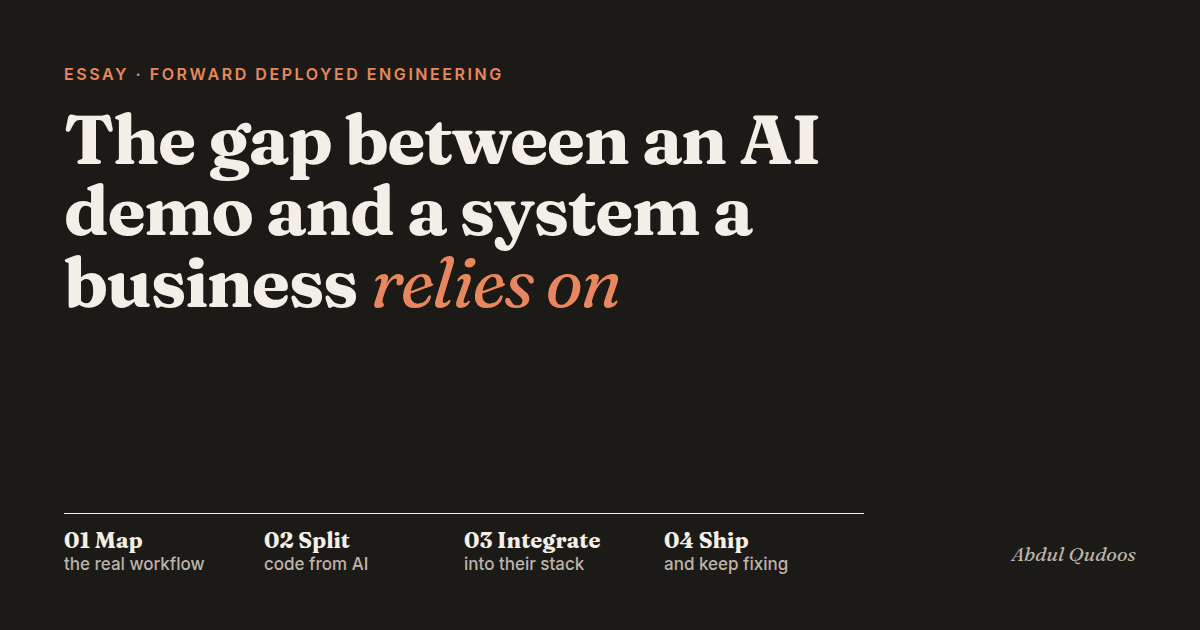
Fix these early. Agentic AI rewards modular design the same way microservices did — but with much faster iteration cycles. Agentic AI is not magic; it is software architecture with LLMs in the loop. Start with a narrow workflow, instrument it heavily, add tools through standards like MCP, and expand scope only when traces prove reliability. That is how demos become features clients pay for.
Share this post: